
Understanding Foam Insulation Boards: The Power of XPS in Modern Construction
Categories
Recent Posts
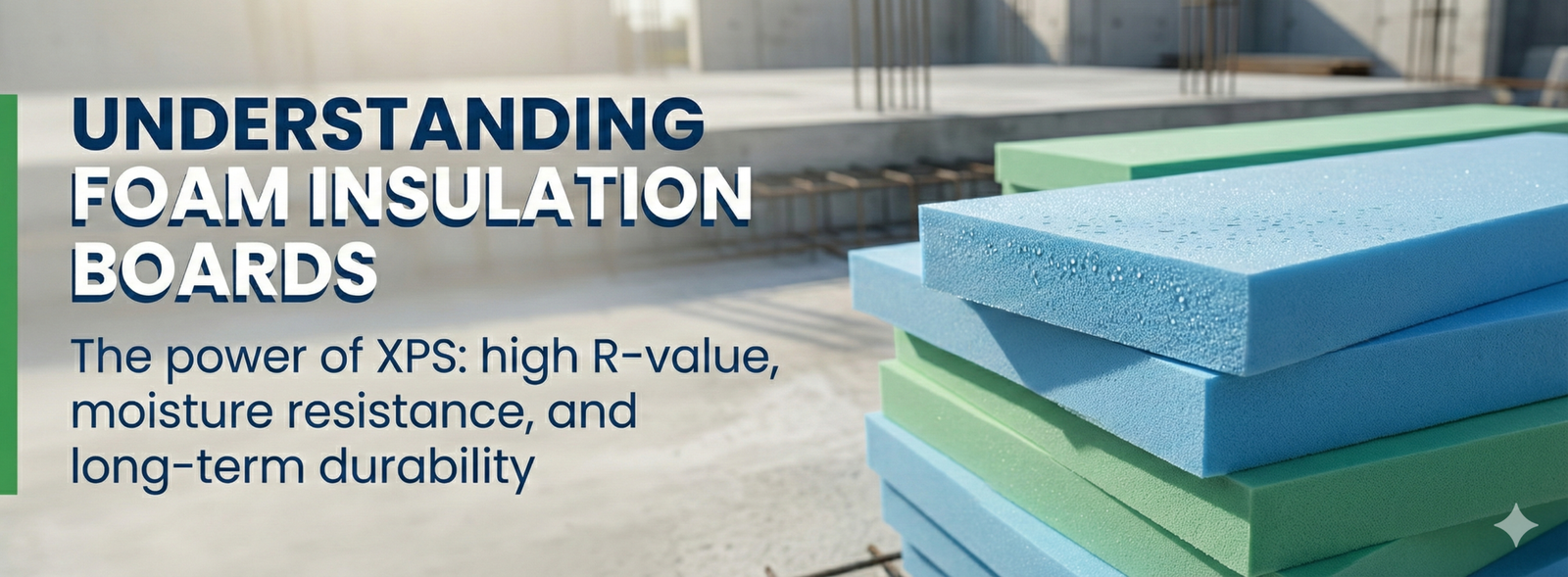
XPS foam stands as one of the most powerful insulation materials in modern construction, offering impressive compressive strengths of up to 700 kPa at 10% deformation . When it comes to building efficiency and durability, few materials can match the performance of extruded polystyrene.
In fact, XPS insulation boards deliver exceptional thermal properties with R-values around 5 per inch of thickness and remarkably low lambda values between 0.029 and 0.036 W/mK . Additionally, these XPS boards and XPS foam sheets provide outstanding moisture resistance, making them ideal for areas prone to water intrusion such as basements and crawl spaces . Furthermore, manufacturers like Soprema offer forty-year warranties on systems using XPS insulation foam , demonstrating the long-term reliability of this material.
Throughout this guide, we’ll explore what XPS foam is, how it differs from other insulation types, and where it performs best in construction applications. We’ll also examine its environmental impact and sustainability features to help you make informed decisions about using XPS rigid foam in your projects.
What is XPS Foam and Why It Matters
Extruded polystyrene (XPS) foam first appeared in 1941, creating an entire insulation material category with its revolutionary closed-cell structure. Unlike other insulations, XPS delivers a unique combination of properties that make it invaluable in modern construction.
Understanding XPS rigid foam structure
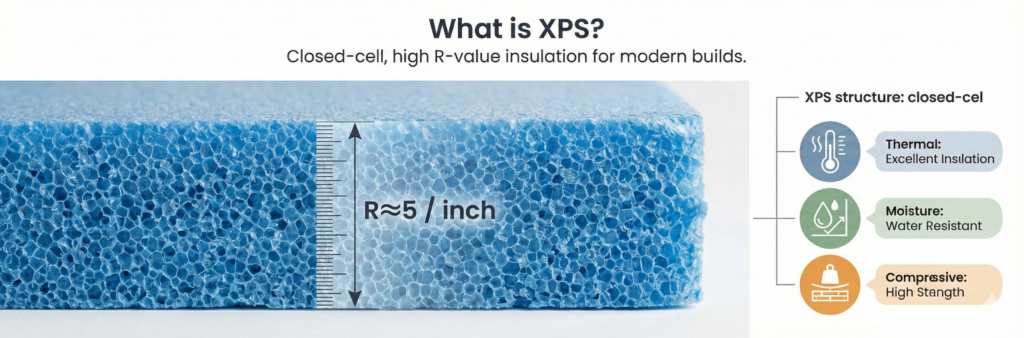
The distinguishing characteristic of XPS rigid foam is its homogeneous closed-cell structure. During manufacturing, polystyrene resin is melted, combined with additives and blowing agents, then forced through an extrusion die under carefully controlled heat and pressure. This process creates a uniform material where each cell is fully enclosed by polystyrene walls with no voids between them.
The closed-cell structure gives XPS its exceptional moisture resistance and enables it to maintain long-term thermal performance even after exposure to challenging conditions like standing water or wet soil. Moreover, this structure allows XPS to retain its high R-value of R-5 per inch while providing significant compressive strength.
How XPS differs from other foam boards
While both XPS and EPS (Expanded Polystyrene) use polystyrene as their base material, their manufacturing processes create substantial performance differences.
XPS absorbs significantly less water than EPS products – typically 0.1-0.3% by volume compared to EPS at up to 4%. Consequently, XPS maintains its thermal properties better in wet environments. XPS also offers higher compressive strength, ranging from 15-100 psi, making it ideal for load-bearing applications.
Another key distinction lies in thermal performance. XPS typically provides R-5.0 per inch, whereas EPS delivers between R-3.8 to R-4.5 per inch. Interestingly, XPS actually performs better at lower temperatures – reaching R-5.4 at 40°F and R-5.6 at 25°F.
Common forms: xps board vs xps foam sheet
XPS is available in several forms to suit different construction needs. Most commonly, it comes as rigid foam boards typically measuring 24″ x 96″ or 48″ x 96″ with thicknesses ranging from just under 1″ to more than 4″.
These boards can be manufactured with or without plastic facings and are easily recognizable by their distinctive colors – usually blue, green, or pink depending on the manufacture. Despite appearing similar, XPS boards and sheets may have different applications based on their specific properties.
XPS can be readily fabricated into various sizes, thicknesses, and edge treatments to meet specific design needs. This versatility, combined with its ease of cutting and installation, makes XPS foam an excellent choice for numerous construction applications.
Key Performance Benefits of XPS Insulation
The exceptional properties of XPS foam make it a standout choice for demanding construction applications. Let’s examine the specific performance benefits that set this material apart from other insulation options.
Thermal resistance and R-value explained
XPS insulation boards deliver consistent thermal performance with R-values ranging from 4.6 to 5.0 per inch, depending on density. R-value measures insulation effectiveness, higher values indicate better thermal resistance. Notably, XPS performs even better at lower temperatures, reaching higher R-values at 40°F than at 75°F.
Long-term studies reveal that XPS maintains superior thermal performance over time. After 5 years in service, XPS boards retained R-values between 4.51 and 5.15 per inch. Even after 31 years, XPS maintained an average R-value of about 4.1 per inch, remarkably higher than alternative materials.
Moisture resistance and waterproofing
The closed-cell structure of XPS rigid foam creates exceptional moisture resistance with an absorption rate of just 0.3 percent by weight. This low water absorption protects against damaging rot and unhealthy mold growth.
Field testing shows XPS absorbs substantially less moisture than alternatives, subsequently maintaining its thermal properties in wet environments. This makes it ideal for applications like below-grade walls, foundations, and inverted roofs where exposure to moisture is inevitable.
Compressive strength and load-bearing capacity
XPS insulation comes in various strength grades with compressive resistance ranging from 15 psi (Type X) to 100 psi (Type V). High-density XPS boards can withstand more than 6,144 lbs/ft² with maximum deformation of just 10 percent.
This impressive strength enables XPS foam sheets to excel in demanding horizontal applications such as floors, flat roofs, and heavily trafficked areas. For critical infrastructure like airport runways and roadways, XPS products resist compressive creep and fatigue, ensuring sustained performance under constant loading.
Durability and long-term performance
XPS foam typically lasts several decades, often matching the building’s lifespan. Its resistance to moisture intrusion, freeze-thaw cycles, and dimensional stability contribute to this longevity.
In one 20-year field study in extreme Siberian conditions, XPS showed minimal degradation despite temperature variations of 90K between summer and winter. The thermal conductivity increased by less than 5% due to moisture and only 5% from cell gas exchange.
The superior durability of XPS insulation boards is further validated by manufacturers who guarantee their products will retain at least 90% of their R-value over 20 years, even when exposed to moisture.
Where XPS Foam Boards Are Used in Construction
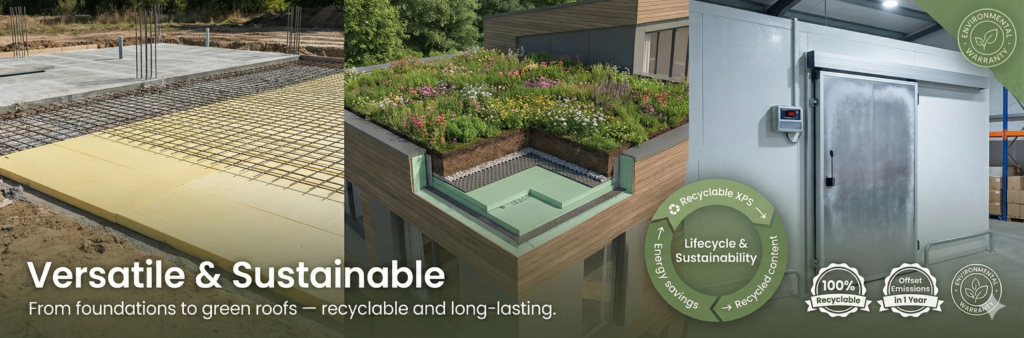
From foundations to rooftops, XPS foam boards provide essential solutions in multiple construction applications where their unique properties offer significant advantages.
Roof insulation (flat and sloped)
XPS boards excel on both flat and sloped roofs, typically installed under roofing membranes or above roof decks to provide continuous insulation against temperature extremes. Their lightweight nature, along with exceptional moisture resistance, makes them particularly suitable for roofing applications where water exposure is common.
Wall and cavity insulation
In cavity walls, XPS insulation helps maintain favorable temperature profiles by placing thermal protection between inner and outer wall leaves. Below the damp proof course (DPC) level, XPS foam can either partially or fully fill the cavity, effectively utilizing its moisture resistance properties. Many builders consider XPS the automatic choice for below-grade wall areas.
Under slab and foundation applications
XPS rigid foam is ideal beneath concrete slabs in both residential and industrial buildings. Its high compressive strength, ranging from 15 psi to 100 psi coupled with excellent moisture resistance makes it perfect for below-grade applications in poured concrete or concrete block foundation systems.
Cold storage and refrigeration
Within refrigeration environments, XPS foam uniquely maintains low thermal conductivity even amidst high moisture and condensation. The closed-cell structure resists freeze-thaw cycles that ground floor insulation often experiences, making it invaluable for maintaining stable temperatures in cold storage facilities.
Green roofs and inverted roofs
For inverted roofs, XPS boards are placed atop the waterproofing layer rather than beneath it. This “upside-down” approach protects the membrane from UV damage and temperature fluctuations, extending roof lifespan by up to 22%. XPS provides an excellent foundation for green roofs, offering high compressive strength necessary for supporting soil, vegetation, and foot traffic.
Sustainability and Environmental Impact of XPS
Beyond impressive performance characteristics, XPS foam offers substantial environmental benefits throughout its lifecycle.
Recyclability of XPS foam sheets
XPS stands out as a 100% recyclable thermoplastic material. Manufacturing facilities typically reprocess all production cut-offs back into the manufacturing stream, achieving zero-waste production. Indeed, some manufacturers now produce XPS boards containing up to 90% recycled polystyrene.
Energy efficiency and reduced emissions
Buildings account for approximately 37% of global greenhouse gas emissions, making XPS’s thermal efficiency essential for sustainability. In fact, studies show that XPS insulation’s energy savings offset its manufacturing emissions within the first year of use. Over time, these energy savings significantly exceed the environmental impact of production.
Eco-friendly manufacturing practices
Manufacturers increasingly adopt sustainable practices, including using non-toxic blowing agents. Meanwhile, some companies implement closed-loop recycling systems where post-consumer XPS is collected, compacted, and repurposed into new products. This approach essentially creates a circular economy for insulation materials.
Fire safety and regulatory considerations
Since the 1970s, fire safety regulations have evolved alongside XPS formulations. Manufacturers incorporate flame retardants that markedly slow fire spread, providing crucial escape time during emergencies. Overall, modern XPS products comply with international fire safety codes through careful formulation and testing processes, balancing performance with safety requirements.
Conclusion
XPS foam insulation stands as a cornerstone of modern construction, offering exceptional performance across critical parameters. The remarkable thermal efficiency with R-values around 5 per inch helps buildings maintain comfortable interior temperatures while significantly reducing energy consumption. Additionally, its unmatched moisture resistance protects structures from water damage, mold growth, and deterioration over decades of service.
The versatility of XPS boards proves invaluable throughout building structures. From foundations to rooftops, this material excels in demanding applications where other insulations might fail. Undoubtedly, its closed-cell structure delivers consistent performance even after years of exposure to challenging environmental conditions.
Beyond immediate performance benefits, XPS foam contributes to sustainability goals through energy savings that offset manufacturing emissions within the first year of installation. The 100% recyclability of this material further enhances its environmental credentials, allowing it to play a vital role in reducing the carbon footprint of buildings worldwide.
The superior compressive strength of XPS makes it particularly suitable for load-bearing applications that other insulations simply cannot handle. This strength, combined with excellent thermal properties, creates a powerful solution for everything from below-grade foundations to green roof systems.
As construction practices continue evolving toward greater efficiency and sustainability, XPS foam insulation remains an essential material that balances immediate performance needs with long-term durability. Whether protecting structures from moisture, maintaining stable interior temperatures, or supporting sustainable building practices, XPS foam delivers exceptional value throughout the building lifecycle.
FAQs
Q1. What are the main advantages of using XPS foam insulation in construction? XPS foam insulation offers excellent thermal efficiency with R-values around 5 per inch, superior moisture resistance, high compressive strength, and long-term durability. It maintains its performance even in challenging environmental conditions, making it ideal for various applications from foundations to rooftops.
Q2. How does XPS foam compare to other insulation materials in terms of moisture resistance? XPS foam has exceptional moisture resistance due to its closed-cell structure, absorbing only 0.1-0.3% water by volume. This is significantly less than other materials like EPS, which can absorb up to 4%. This property allows XPS to maintain its thermal performance even in wet environments.
Q3. Is XPS foam environmentally friendly? Yes, XPS foam is 100% recyclable and contributes to energy efficiency in buildings. Its energy savings typically offset manufacturing emissions within the first year of use. Many manufacturers are adopting eco-friendly practices, including using recycled content and implementing closed-loop recycling systems.
Q4. What is the typical lifespan of XPS foam insulation? XPS foam insulation can last for several decades, often matching the lifespan of the building it’s used in. Manufacturers often guarantee that their XPS products will retain at least 90% of their R-value over 20 years, even when exposed to moisture.
Q5. Where is XPS foam commonly used in construction? XPS foam is versatile and used in various applications including roof insulation (both flat and sloped), wall and cavity insulation, under slab and foundation applications, cold storage facilities, and green roofs. Its properties make it particularly suitable for areas prone to moisture exposure or requiring high compressive strength.